Someone asked me recently if I'd changed my organisation processes since writing this post in 2014. In fact, almost everything I mentioned in that post has changed!
Just recently I was fired for the first time ever. I was just settling down after the shock of switching from freelancing a couple days a week and spending the rest of the time on my own projects to working full-time for someone else when I was told to pack my bags and leave.
So I had to make a big adjustment all over again. Aside from the financial stress, I'm a lot happier with my current work set-up, but it did require a rethink of how I manage everything. I have so many different projects and contexts of work to think about now that I was worried I'd forget things or miss deadlines.
I spent a few weeks exploring different options before settling into my current process. I use a paper Leuchtturm1917 notebook with a modified Strikethru system that I talked about here, and Todoist to stay on top of everything.
- After the pedal-to-the-floor, all-hands launch of Todoist Foundations last fall, our product teams took a few months to pursue smaller Todoist updates they’d been waiting to get to. Read on to learn what’s new in Todoist and discover new ways to save time and stay organized. Build time-saving workflows with updated iOS 13 Shortcuts.
- Todoist gives you the confidence that everything’s organized and accounted for, so you can make progress on the things that are important to you. Start each day feeling calm and in control Get a clear overview of everything on your plate and never lose track of an important task.
My notebook is for planning what to do each day, and Todoist helps me stay on top of longer-term project planning and repeating tasks with reminders.
Projects
I mostly rely on filter views in Todoist, but I do have a bunch of projects set up to give tasks more context when I'm working outside the project view. My project tree looks like this:
- Coding
- Exist for iOS
- App Store version
- HealthKit branch
- Location branch
- New features
- Littlelogs for iOS
- ToRead
- Journal
- Notes app
- Larder for iOS
- Project ideas
- Exist for iOS
- Personal
- Calendar
- Bills
- Shopping
- Goals
- Hello Code
- Content
- Exist
- Littlelogs
- Larder
- Writing
- Topics
- Field Trip
- Productive Habits course
- BBC blog
- Clients
- Client 1
- Client 2
- etc.
12:45 - When Amir started to get serious about Todoist, he began to focus on SEO tactics, implementing analytics, and concentrating on the upgrade paths to premium tiers. He then focused on developing mobile apps for the product. 35,903 likes 114 talking about this. The to-do list to organize work & life. Todoist Tip: Timeblock your tasks by using Todoist and your Google Calendar in tandem. Set a custom event duration for a Todoist task by adding 30m to the task name. When saved, the task will appear as a new Google Calendar event with a duration of 30 minutes.
Exist for iOS is my most tricky project to organise. It's pretty much the only reasons I've been trying so many different digital task managers recently, because several others fit my working style for everything but this project. The issue is that it's a big project with different branches (each sub-project represents a code branch where I'm working on different things) and different task contexts within it: fixing bugs, building new features, refactoring code, etc.
In the future I'd like to see fewer sub-projects under Exist for iOS, but the Apple Health integration took much longer than I expected, so I ended up having to manage the App Store version separately, so I could ship small bug fixes to the App Store quicker than if they were bundled in with the HealthKit branch. I also started the location branch far too soon—I was overconfident that the Apple Health integration was pretty much done and wanted to work on something new, but I've had a few setbacks since that have held up releasing the HealthKit branch into the App Store.
Some of the other projects listed under Coding are not even started yet, but I'd like to build them someday.
My Calendar project holds calendar items as tasks that I create automatically using this IFTTT recipe.
Otherwise, the project set-up is fairly straightforward.
Labels
I have a few different types of labels, so it would be nice if I could group them together for easier reading. Todoist doesn't offer this functionality, but in my mind they're grouped, so that's how I'll explain them.
Coding
- @feature
- @bugs
- @optimisation
- @refactor
I tend to work on the same types of coding tasks at once—for instance I'll spend a day fixing bugs, so I want to just see the tasks labelled @bugs.
Writing
- @post
- @outlined
- @drafted
- @needs-revision
- @update
I use the @post label for any task that is actually a post I need to write. Then I can just look at what writing I need to do, without seeing all the writing-related admin tasks as well.
The rest of these labels help me keep track of what stage each post is at, so I know what the next step is.
Other
- @waiting
I use this label to show that I can't move forward on a task until someone else does their part. I use it for posts that have been sent to an editor, or projects that are held up by someone else.
Filters
Working on
I spend most of my time in this filter view. It's split into three sections:
- overdue tasks
- tasks due in the next 7 days (sorted by date)
- anything in progress or that I want to work on next
This last section is created by searching for tasks with priority 1 status. Since Todoist doesn't have a star or flag feature (you might see these in apps like Wunderlist or 2Do), I use priority 1 as a replacement. I use priority 2 and 3 within lists, but priority 1 is reserved for pushing tasks into this list.
Using the priority flag means I can push tasks into my 'Working on' filter without giving them a specific due date. I don't want these tasks to get overdue or to feel like burdens—I just want them to be visible when I'm wondering what to work on next.
Follow up
This is just a filter for any task with the label @waiting.
Forgotten tasks
Any tasks that doesn't have a due date that falls in particular projects gets filtered into here. I don't include long-term projects that include lots of steps to complete. The projects that can push tasks into this list are ones where I've noted down errands, bills to pay, or admin tasks that need to get done at some point.
Having this filter set up means I can confidently throw tasks into Todoist that I want to do at some point in the future without worrying that I'll forget to schedule them.
Exist for iOS
The best part about Todoist filters is the ability to separate the filtered list into sections for each different query. For instance, a filter search of @waiting, (p:personal & !due) will make a list with two sections: one for @waiting tasks, and one for tasks without a due date in my 'personal' project.
For my Exist for iOS filter, I've created a filtered list that breaks all of my Exist for iOS tasks into sections for each sub-project. So I have a section for my App Store branch, a section for my HealthKit branch, and so on—but I can see them all on one screen.
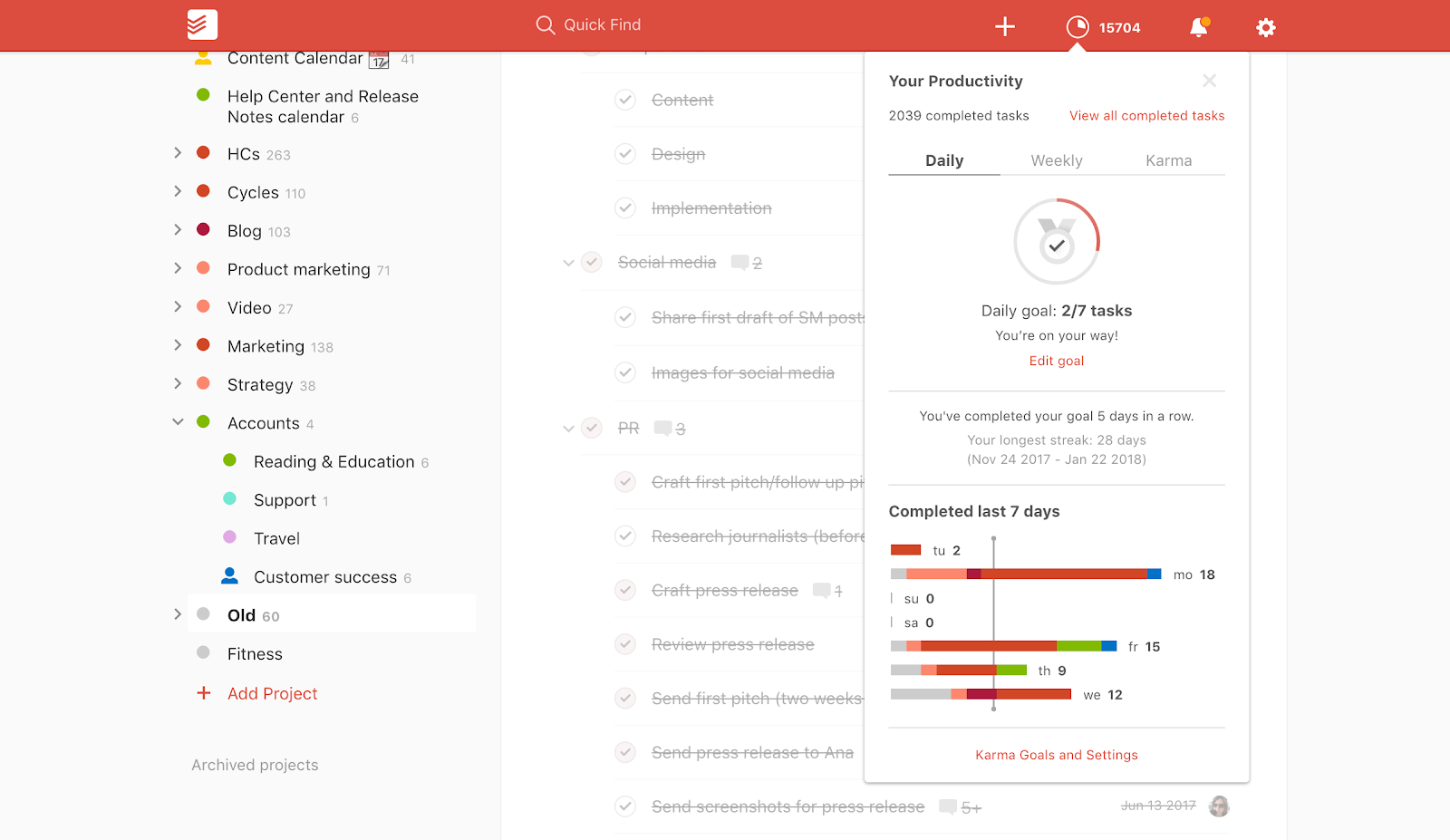
Todoist Analytics App
Exist for iOS bugs
This filter only shows tasks labelled @bugs in my Exist for iOS project. It's also broken into sections for each sub-project, so I know which branch each bug relates to.

Posts to write
This filter shows any task with the label @post. It's separated into sections for all my client work, my personal writing, and Hello Code-related blog posts.
Clients
When I want to get an overview of all the client work I have due or coming up, I use this filter. It shows both posts I need to write and other tasks, and it's separated by sub-projects: one for each client.
Usage
When it comes to actually getting things done and staying organised, here's how I work:
If I want to work on a particular task next/soon, I make it priority 1 so it shows up in my 'Working on' filter. This is where I spend my time when I'm working and checking what's up next.
Every now and then I try to check my 'Forgotten tasks' filter to see if I need to schedule anything from that list.
To quickly add a task I use Todoist's quick-add shortcuts. Pressing 'q' inside Todoist brings up a simple, easy-to-use box to quickly enter a task, choose a due date, and pop it into a project. I sometimes use the quick-add box that pops up when you hit cmd+shift+a in any app, but this one is a bit more overwhelming than the in-app option.
One thing I'm trying to change when working with Todoist is to only add tasks I really think I'll do someday. I've been guilty in the past of filling up my task managers with any task I can think of. This inevitably ends up in a task manager that's crowded, and full of stale tasks I've forgotten I ever added.
These days Todoist is fairly clean, and full of tasks I actually want to do. I try to be ruthless about removing anything that's no longer relevant, rather than letting my Todoist account get cluttered and overfull.
P.S. I make some stuff you might like: Exist, a personal analytics app to help you understand your life, and Larder, a bookmarking app for developers.
This post is also available in: 日本語
Introduction
This article explains the task management tool Todoist. Speaking of task management tools, recently there are more and more tools with various functions such as kanban format, Gantt chart, Google calendar integration, reminders, sub-task registration, etc. Todoist is an attractive task management tool that can be used while keeping it as simple as possible to use. Todoist has an intuitive interface that helps you get into the habit of managing tasks.
What Is Todoist?
Todoist is a simple task management tool run by Doist, an international company. Rather than being multifunctional, the appeal of Todoist is that it allows you to focus on task management with limited features.
Introducing Todoist’s features
What is Todoist, roughly, and what kind of service is it? Here’s a quick rundown of the key points.
- A free task management app.
- You can manage tasks in a simple list format.
- You can also use the app.
- Easy checklist management
Free Task Management App
Todoist is free and ready to go. If you want to use more advanced features, there is a paid plan. Paid plans are explained in the second half of this article.
Todoist Analytics Login
Manage your tasks in a simple list format
Todoist is a list of tasks to manage, whereas Trello is a list of cards that you can move around in a kanban format.
You can also use the app.
Todoist is available in the browser as well as the smartphone app. The data is synced instantly, so you can rest assured that your data is in sync. You can also use it as an add-on for Apple Watch, Gmail, or as a Google Chrome add-on, so you can sync your task management in almost any environment.
Easy checklist management
Todoist has a sub-task feature. This allows you to create a checklist (parent-child tasks). You can also effectively organize tasks that generate We will discuss subtasks in the next basic usage part.
Basic usage of Todoist
Here’s a basic explanation of how to use Todoist. It’s very simple to tell you ahead of time. Here is the main screen. This is where you manage your tasks.
Setting up a task
First, let’s set up a task. Click on the “Add Task” button. After that, you can enter “task content”, “due date”, “priority”, etc. as shown in the following GIF.
Setting Priorities for Tasks
You can set a priority level for the tasks you create in Todoist. You can set the priority by clicking the “Flag” icon on the task entry screen. There are four levels of priority, and you can color them to organize them.
The task list is automatically ordered by priority.
It is also possible to rearrange the order of the list, as long as it is within the same priority level.
Add a subtask
Todoist has a feature to add subtasks. In general, these are called parent-child tasks or checklists, which are management of multiple detailed tasks that are linked together to perform a single task. It’s like a checklist for a single task.
Todoist Analytics Download
Let me explain how to enter sub-tasks in Todoist specifically. On the task entry screen, click “Add Sub-Task”.
Enter a subtask.
The schedule can of course be assigned a priority to the subtasks. It is also possible to add more grandchildren tasks that are tied to the subtasks you set.
You can delete a task by clicking the “circle” next to it.
Todoist Pricing Plans
As mentioned above, Todoist can use the basic plan for free. If you want to use more advanced features, you’ll need to upgrade to a higher-end premium or business plan. Even with the upgrade, the top level plan is still very reasonable with a monthly fee of $558 per person.
Todoist Analytics Software
Here are the main features you can use with the top level plan
- Reminder function: You can be reminded of task due dates.
- Label & filter features: label and filter tasks and organize them
- Commenting and File Uploading: allows for commenting and file uploading.
- Productivity trends: an insightful feature.
Finally.
Throughout this article, we have explained how you can use the simple task management tool Todoist. I hope you have found out that you can manage tasks intuitively and simply. That’s the end of this article on Todoist.