
Feb 10, 2017 Lunar Orbit Insertion, on the surface, appears to be a standard orbital mechanics problem, solvable using straightforward, albeit sophisticated tools to calculate a solution. In reality, the message from the computers is, 'If you want to get into lunar orbit, well, you can't get there from here.' Not easily, that is. The moon orbits quite fast: it moves about 0.5 degrees per hour in the sky. In 24 hours it moves 13 degrees. The moon's observed motion eastward results from its physical motion of the moon along its orbit around the Earth. The distance from the Earth to the moon is about 60 times the Earth's radius, about 384,000 km. THE MOON'S ORBIT On average, the Moon is about 384,400 km (almost a quarter million miles) from the Earth. But the actual distance varies; sometimes the Moon is closer, and other times it is farther away. This variation is due to the Moon's elliptical orbit.
By Aparna Kher
The Moon's orbit around Earth is elliptical. The point of the orbit closest to Earth is called perigee, while the point farthest from Earth is known as apogee.
Elliptical Orbit
The Moon's orbit around Earth is elliptical, with one side closer to Earth than the other.
As a result, the distance between the Moon and Earth varies throughout the month and the year. On average, the distance is about 382,900 kilometers (238,000 miles) from the Moon's center to the center of Earth.

The point on the Moon's orbit closest to Earth is called the perigee and the point farthest away is the apogee.
Supermoons & Micromoons
The Moon's phase and the date of its approach to its perigee or apogee are not synced. When a Full Moon or New Moon occurs close to the Moon's perigee, it is known as a Supermoon. On the other hand, when a Full Moon or New Moon occurs close to the Moon's apogee, it is known as a Micromoon.
The Moon passes through the 2 extreme points–or apsides–perigee and apogee about once a month. The time it takes for the Moon to travel from perigee to perigee, is called the anomalistic month, and takes around 27.55455 days.
This is not to be confused with the synodic month, which lasts a little longer, and is the time it takes the Moon to orbit once around Earth, from New Moon through all the Moon phases to the next New Moon.
Close to Earth
The Supermoon on November 14, 2016, was the closest a Full Moon has been to Earth since January 26, 1948. The next time a Full Moon is even closer to Earth will be on November 25, 2034 (dates based on UTC time).
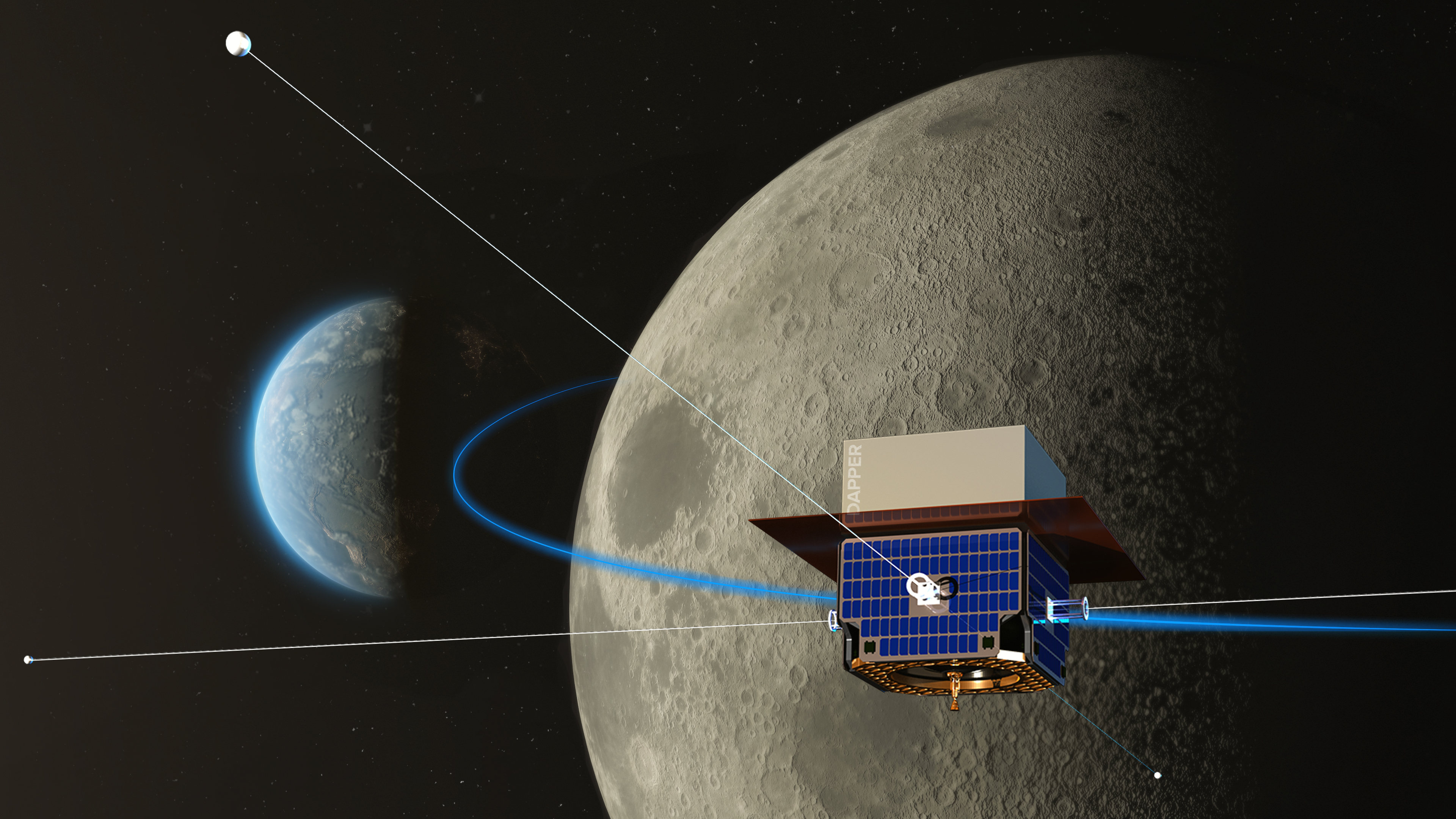
Lunar Orbit Insertion
Moonrise is the best time to view the Moon, weather permitting, of course. At this time, illusion mixes with reality to make a low-hanging Moon that looks unnaturally large when compared to foreground objects.
Lunar Libration
In addition to its counterclockwise orbit around Earth, the Moon rotates around its axis at a constant speed. Like all celestial objects with elliptical orbits, the Moon's speed varies on its path around the Earth. It speeds up when it is at its perigee and slows down when it is at the apogee. This means that at its perigee, the Moon's orbital speed is faster than its rotational speed.
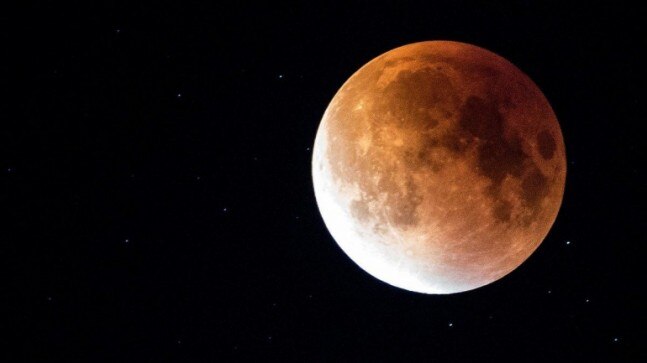
When the Moon rocks slightly from north to south and wobbles a little from east to west, it is called lunar libration. This motion makes it possible, over time, to see up to 58% of the Moon’s surface from Earth, but only 50% at a time.
Perigean and Apogean Tides
The greatest difference between high and low tide is around Full Moon and New Moon, known as spring tides or king tides. During these Moon phases, the gravitational forces of the Moon and the Sun combine to pull the ocean’s water in the same direction.
Perigean spring tides have around 5 cm (2 inches) larger variation than regular spring tides, while apogean spring tides have around 5 cm (2 inches) smaller variation than normal spring tides.
Natural Disaster Trigger?
Although the Sun and the Moon’s alignment cause a small increase in tectonic activity, the effects of the Supermoon on Earth are minor. Many scientists have conducted studies and haven’t found anything significant that can link the Super Moon to natural disasters.
According to NASA, the combination of the Moon being at its closest and at Full Moon, should not affect the internal energy balance of the Earth since there are lunar tides every day.
| Journal Home Page |
Lunar Orbit Insertion
Frank O'Brien
© 1999 Frank O'Brien. All rights reserved.
Lunar Orbit Insertion, on the surface, appears to be a standard orbital mechanics problem, solvable using straightforward, albeit sophisticated tools to calculate a solution. In reality, the message from the computers is, 'If you want to get into lunar orbit, well, you can't get there from here.' Not easily, that is.Significant constraints are built into, or inherent in the Apollo system, that all conspire together to prevent a LOI burn which satisfies all the mission objectives.
Obvious among these objectives is that the orbital plane must go over the landing site, but as well as that, the approach azimuth to the target site (the angle of the approach path, relative to north) must also be acceptable. All landing approaches were made generally from the east, with the Sun behind the crew to provide adequate lighting. Additionally, as a compromise between delivering the spacecraft as close to the Moon as possible and not wishing to actually hit it, the LOI burn should not occur below 110 kilometres, which will be the initial pericynthion of the orbit. Apocynthion can be in the order of 300 km, to be lowered to a 17 km pericynthion after a safe orbit has been established.
The design of the Apollo system is a trade off of necessary and widely contradictory requirements, and many factors constrain the LOI burn and the trajectory which leads to it. Payload weight is the most critical parameter that must be managed. During premission planning, the nominal mission profile is developed together with a variety of abort scenarios. The Service Module is then fueled with only enough propellants to satisfy these parameters, as fuel not loaded is exchanged for additional payload in the form of fuel and experiments for the Lunar Module. In addition, the LM is also subject to tradeoffs between fuel and payload. In the end, the propellant margins are very tight on both the CSM and LM. Therefore, with an eye on the overall spacecraft weight, LOI must be optimized for the least burn time to conserve fuel for possible contingencies.
Limitations of the onboard computer, combined with the requirement to maintain a fixed attitude during the burn, make it difficult to efficiently enter the desired orbital plane. The necessity to maintain a fixed attitude during LOI is for operational simplicity as it is far easier for the crew to monitor the burn, and to notice any deviation from the norm when the vehicle is held in a steady attitude. Spacecraft position and velocity must be very close to the preplanned values at LOI, a necessary requirement but very difficult to achieve in practice. Errors that appear to be small can easily have large effects upon LOI.
One of the more familiar mandates in LOI planning is a free-return trajectory to the Moon to return the crew towards Earth if the spacecraft's big SPS engine should fail, an absolute essential for crew safety. Such a trajectory is a rather high energy path, which necessitates a very large (~1,000 m/s or 3,000 fps) maneuver to achieve orbit insertion, consuming a large percentage of the available fuel for the SPS. A poorly planned LOI might result in uncomfortably tight fuel margins.
Unfortunately, there are several cases where trying to solve for LOI objectives is theoretically impossible, mostly because of allowable fuel limits and guidance restrictions. Trajectory uncertainties are always a problem, and more so than one would suspect, as it will introduce errors to the final orbit.

Since mission 'rules' ('requirements', actually) can never be satisfied, FIDO (Flight Dynamics Officer) has 10 different solutions computed, each which tries to violate only one of the premission requirements. It is then up to FIDO to decide which solution violates the requirements the least. It is this final compromise solution that is sent up to the spacecraft, and is referred to as the 'target' or 'targeting solution'. These ten solutions are organized into three groups of three maneuvers, plus a single maneuver.
The single maneuver achieves an orbit with the smallest fuel expenditure, in exchange for the likely situation that none of the orbital objectives will be achieved. This solution would never be used except in the case where a landing would not be attempted and an alternate mission plan is in effect. This minimal Delta-V case does have the essential quality, however, of defining the lower bound for the remaining LOI solutions. FIDO will compare the nine remaining solutions against this value in determining the optimal maneuver.
The remaining three groups are called the basic, lunar orbit shape, and lunar landing site solutions. Maneuvers within each group will satisfy at least one, and perhaps two targeting objectives at the possible expense of violating one objective.
From the basic set of solutions, FIDO could target the spacecraft over the landing site at any one of three acceptable azimuths. While the requirement for ensuring that the orbit's plane passes over the landing site is readily apparent, the ground track, or azimuth, to the landing site is also important. Selecting an acceptable azimuth was vital, as Apollo's 15, 16 and 17 were all targeted between two mountain ranges at key points of their descent. None of these solutions came without a cost, as the basic solutions defined the most fuel intensive maneuvers.
Subsequent out-of-plane maneuvering would be very expensive in terms of propellant usage, and the LM simply cannot afford its margins cut. While the obvious concern is that the LM not hit the mountains during its descent, of equal importance is that the approach path match the terrain model stored in the computer. If the terrain the LM is flying over doesn't match the model that is stored, misleading information is used by the guidance computer, which would then be presented to the crew.
A second set, the lunar orbit shape solutions, ensure that the apocynthion and pericynthion constraints are met, at the possible expense of the other constraints. A consequence of limiting the problem to a specified maximum Delta-V is that some solutions may not exist, or if they do exist, may not pass over the landing site. Finally, the lunar landing site solutions ensure that the spacecraft will pass over the landing site at an acceptable azimuth. Much like the basic set in its objectives, it also introduced fuel constraints to the problem. As a trade-off, a lower pericynthion would be exchanged for a lower fuel requirement. Unfortunately, this constraint could result in a situation where a solution could not be found.
Lunar Orbit Days
Planning and executing the Lunar Orbit Insertion maneuver is an example of the teamwork between the flight controllers and the crew. As one could expect, the magnitude of this computing problem is such that it could never be performed using the limited resources aboard the spacecraft. Additionally, a team of trajectory analysts are necessary to develop a consensus solution that is impossible to program into a computer. The crew, which takes this information and loads it into the computer, must perform and monitor the burn on the far side of the Moon, without assistance from the ground.
Low Lunar Orbit
These files are copyright © 1998. Frank O'Brien and W. David Woods.
Last updated 2017-02-10| Journal Home Page |